
Nevada LLC for Non-US Residents: The Complete 2026 Guide
Global Operations
eCorp Services

If you're not a US citizen or permanent resident, you might assume forming a US LLC is complicated, restricted, or out of reach. It's not.
Non-US residents can legally form and own a US Limited Liability Company. There are no citizenship requirements, no residency requirements, and no minimum time you need to spend in the United States. International entrepreneurs from India, the UAE, Nigeria, the UK, Canada, and virtually every other country form US LLCs every year.
This is the complete guide to forming your Nevada LLC as a non-US resident in 2026 — covering eligibility, the formation process, banking, taxes, and what to expect ongoing. For a dedicated landing page built specifically for international founders, see our Nevada LLC for International Founders guide →.
---
Can a Non-US Resident Form a US LLC?
Yes — absolutely. The United States allows foreign nationals to own and operate US business entities, including LLCs. There is no federal law prohibiting non-citizens from forming a US company.
- What you do not need:
- US citizenship
- US permanent residency (Green Card)
- A Social Security Number (SSN)
- A US residential address
- A physical presence in the United States
- What you do need:
- A valid passport
- An EIN (Employer Identification Number — explained below)
- A registered agent with a Nevada address (eCorp provides this)
- Payment for state filing fees (~$425)
That's the short list. The process is more accessible than most international founders expect.
---
Why Nevada for Non-US Residents?
Nevada is consistently ranked as one of the best US states for international entrepreneurs. Here's why it stands out:
Privacy protection Nevada does not require LLC member names to appear on public filings. Your name, address, and ownership stake remain private. For international founders who value discretion, this is a significant advantage over states like Florida or California.
No state income tax Nevada imposes no personal income tax and no corporate income tax. This reduces your overall tax burden — particularly relevant if your LLC income is not subject to US federal taxes (which depends on your specific situation; see the tax section below).
No information-sharing with the IRS Nevada is one of the only states that does not share business tax information with the Internal Revenue Service. This is a unique protection not available in most other states.
Strong asset protection Nevada's charging order protections are among the strongest in the country. If someone sues you personally, a Nevada LLC structure makes it very difficult for creditors to access your business assets.
Well-established legal framework Nevada has a dedicated Business Court and decades of case law governing LLCs. This provides legal clarity and predictability for business owners.
eCorp's Nevada specialization eCorp is headquartered in Henderson, Nevada. We specialize exclusively in Nevada formations — meaning we know the state's requirements, timelines, and nuances better than generalist formation services that file in all 50 states.
---
Who Is a Nevada LLC For?
International founders form Nevada LLCs for a wide range of businesses:
- Consulting and professional services provided to US clients
- E-commerce — Amazon FBA, Shopify, Etsy sellers targeting the US market
- Software and SaaS products with US customers
- Agencies managing US client marketing, design, or development work
- Content businesses monetized through US platforms
- Import/export businesses with US trading partners
- Real estate investment (US property held through an LLC)
- Holding companies for broader international business structures
If your business touches the US market — through customers, suppliers, platforms, or payment processors — a US LLC gives you legitimate standing to operate, invoice, and receive payments as a US business entity.
---
Step-by-Step: How to Form Your Nevada LLC
Step 1: Choose and Verify Your LLC Name
Your name must be unique in Nevada's registry. Check availability at the Nevada Secretary of State website before you commit — eCorp runs this search as part of the formation process.
Names to avoid: anything that implies government affiliation, suggests a regulated profession you're not licensed for, or contains restricted terms (bank, insurance, trust) without appropriate licenses.
Step 2: Appoint a Registered Agent
Nevada law requires every LLC to have a registered agent — a person or company with a physical Nevada street address who receives legal and official documents on your behalf.
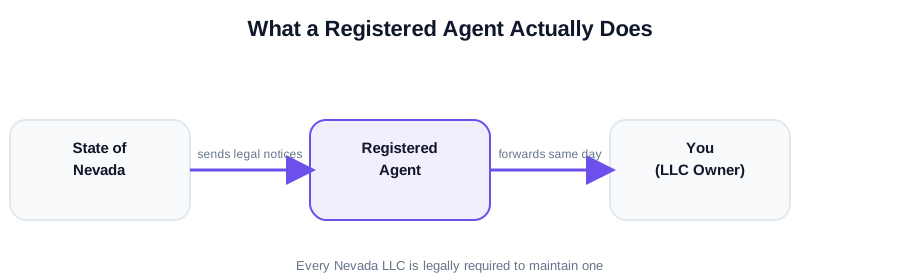
As a non-US resident, you almost certainly don't have a Nevada address. A professional registered agent is not optional. eCorp provides this with every formation plan. Your registered agent's address becomes your LLC's official Nevada address.
Why this matters: If your LLC is sued or receives a legal notice, the registered agent receives it and forwards it to you immediately. Miss that notice, and you could face a default judgment. For a deeper look at what the role covers, see Registered Agent Explained →.
Step 3: File Your Articles of Organization
The formation document that officially creates your LLC with the state.
- Nevada state fees:
- Articles of Organization: $75
- Initial List of Members/Managers: $150
- State Business License: $200
- Total: ~$425
Standard filing: 2–3 weeks. eCorp Pro plan: rush filing 3–5 business days. Premium: 1–3 business days.
Step 4: Obtain Your EIN
An EIN (Employer Identification Number) is your federal tax ID from the IRS. You need it for banking, payments, and tax filing.
Non-US residents cannot use the IRS online application — it requires an SSN. Instead, you apply by phone, fax, or mail using Form SS-4. The phone method (IRS International line: +1-267-941-1099) gets you your EIN same day if the call goes smoothly.
This is often the most confusing step for international founders. eCorp's Pro and Premium plans include full EIN obtainment. Full guide: How to Get an EIN Without an SSN →
Step 5: Draft Your Operating Agreement
An operating agreement defines how your LLC is governed. Nevada doesn't legally require one, but you should always have one — banks often require it, it reinforces your liability protection, and it governs your ownership structure.
eCorp's Pro and Premium plans include a professionally drafted operating agreement.
Step 6: Open a US Business Bank Account
A US bank account is critical. Mercury is the recommended starting point for international founders: fully remote application, no monthly fees, strong compliance team that understands non-resident structures.
What you'll need: Articles of Organization, operating agreement, EIN confirmation letter, and a valid passport.
Full guide: How to Open a US Bank Account Remotely →
Step 7: Set Up Annual Compliance
| Obligation | Due | Fee |
|---|---|---|
| Annual List of Members/Managers | Annually, LLC anniversary | $150 |
| Nevada Business License Renewal | Annually | $200 |
| Federal Tax Return | Annually (April 15 or June 15) | Varies |
| Registered Agent | Continuously | Included with eCorp |
Missing the Annual List puts your LLC in "default" with the state, which can result in fines and eventual revocation. eCorp's compliance calendar tracks all deadlines automatically.
---
Understanding US Taxes as a Non-Resident Owner
Tax is the most complex topic for international LLC owners. Here's a clear overview:
The LLC is a pass-through entity. By default, a single-member LLC is a "disregarded entity" — it doesn't pay federal income taxes. Income passes to you personally.
- US federal tax depends on income source:
- *US-sourced income* (from US clients, US platforms, US activities) is generally subject to US tax.
- *Foreign-sourced income* (from non-US clients for services outside the US) is generally not.
Annual filing is required regardless. Foreign-owned US LLCs must file Form 5472 annually — even if no taxes are owed. Missed filings can trigger penalties of $25,000+ per violation.
Your home country taxes still apply. Most countries tax residents on worldwide income. Even with a US LLC, you may owe taxes domestically. Always work with a tax professional who understands cross-border structures.
---
Common Mistakes Non-US Residents Make When Forming a US LLC
Using a personal address as the business address This creates personal liability exposure and may be inaccurate if you don't have a Nevada address. Use your registered agent's Nevada address as the LLC's official address.
Skipping the operating agreement Banks will often reject your account application without one. Courts may also question your LLC's legitimacy without one. Always have it drafted.
Using the wrong EIN application process The IRS online EIN tool requires an SSN. Non-residents who try to use it end up rejected or stalled. Use Form SS-4 by phone, fax, or mail — or use eCorp's EIN service.
Not filing annual returns The IRS penalties for missed informational filings (Form 5472) are severe. Many foreign LLC owners mistakenly believe that owing no tax means filing no return. That's not correct.
Choosing the wrong state based on cost alone Wyoming is cheaper upfront. Delaware has better venture capital positioning. But Nevada's combination of privacy, asset protection, and no state income tax makes it the strongest all-around choice for most international entrepreneurs, especially those who value discretion. See our full Nevada vs. Wyoming comparison →
---
eCorp's International Formation Service
eCorp specializes in Nevada LLC formations for international entrepreneurs. We understand the specific challenges non-US residents face — from the EIN application process to banking documentation to ongoing compliance — and we've built our service around solving them.
- Our Pro Plan ($349/yr + state fees) includes everything a non-resident needs to get fully operational:
- Nevada LLC formation (rush 3–5 business day filing)
- Professional registered agent service (full year)
- EIN obtainment (we handle the SS-4 process)
- Custom operating agreement
- Compliance calendar with automatic deadline reminders
Our Starter Plan ($199/yr + state fees) covers the essentials for founders who want to handle their EIN and operating agreement independently.
View our plans and get started →
---
Note: This guide provides general information only and does not constitute legal or tax advice. Business formation and tax requirements vary by individual circumstances. Always consult qualified legal and tax professionals for advice specific to your situation.