
Nevada LLC for Digital Nomads: How to Run a US Business from Anywhere in the World
Global Operations
eCorp Services
You're running a business from a laptop. Maybe you're in Bali this month, Lisbon next month, and Tokyo the month after that. You have clients, you're making money, and now you need a proper business structure that works globally — without tying you to a single location.
A Nevada LLC might be exactly what you're looking for.
In this guide, we break down why Nevada is one of the most popular states for digital nomads forming US companies, what the process looks like, and the practical steps to get your LLC operational while you're anywhere in the world.
---
Why Digital Nomads Form US LLCs
You don't have to be American to form a US LLC. And you don't have to live in the US to run one. Tens of thousands of location-independent entrepreneurs choose to structure their businesses through a US LLC every year for several compelling reasons.
Access to US payment infrastructure Stripe, PayPal, Shopify Payments, and most major payment processors work seamlessly with US LLCs. International businesses often face restrictions, higher fees, or outright payment blocks on these platforms. A US LLC changes that.
Client trust and credibility US-based clients — particularly businesses — are often more comfortable transacting with a US entity. An invoice from "Acme LLC" (Nevada) reads differently than an invoice from a foreign sole trader. For B2B service providers, this alone can justify the formation cost.
Privacy protection Nevada is one of the best states in the US for business privacy. Member names are not publicly listed in Nevada LLC filings. For digital nomads who value personal privacy, this matters.
No state income tax Nevada charges no personal or corporate state income tax. If your business operates primarily outside the US, you may owe little to nothing in US taxes — though this depends on your residency status, where your clients are, and whether you have US-sourced income. Always consult a tax professional about your specific situation.
Asset protection Nevada's LLC laws offer strong personal liability protection. Your personal assets (savings, property) are generally shielded from business debts and lawsuits.
---
Is a Nevada LLC the Right Choice for Your Nomadic Business?
Nevada works particularly well for digital nomads in these situations:
- Freelancers and consultants providing services to US-based clients
- E-commerce sellers on Amazon, Etsy, Shopify, or similar platforms
- SaaS founders monetizing via Stripe or similar US payment processors
- Agency owners managing client accounts and campaigns remotely
- Content creators monetizing through US platforms (YouTube, Substack, Beehiiv, etc.)
- Online course creators selling through platforms like Teachable or Kajabi
If your business is entirely conducted with non-US clients, paid in foreign currencies through local processors, with no US-sourced income, a US LLC may have less obvious financial benefit — though it can still provide structural and credibility advantages.
---
Do You Need to Visit the US to Form a Nevada LLC?
No. The entire Nevada LLC formation process can be completed remotely. You do not need to set foot in Nevada — or anywhere in the United States — to form your LLC, obtain your EIN, or open certain US bank accounts.
Here's what you'll need:
- A valid passport (the primary identity document for non-residents)
- A registered agent in Nevada (required by state law — eCorp provides this)
- Filing fee payment (credit card accepted online)
That's it. No US address, no Social Security Number, no in-person visit.
---
Step-by-Step: Forming Your Nevada LLC as a Digital Nomad
Step 1: Choose Your LLC Name
Your LLC name must be unique in Nevada's business registry. It must include "LLC," "L.L.C.," or "Limited Liability Company."
- Tips:
- Check name availability on the Nevada Secretary of State website, or let eCorp run the search for you
- Avoid names that imply you're a bank, government entity, or regulated profession
- If you plan to operate under a different brand name, you can register a DBA (Doing Business As) after formation
Step 2: Appoint a Registered Agent
Every Nevada LLC must have a registered agent — a person or company with a physical address in Nevada who receives legal and official documents on your behalf.
As a digital nomad, you almost certainly don't have a Nevada address, making a professional registered agent service essential. eCorp provides this as part of every formation plan. Your registered agent address becomes your LLC's official address in Nevada.
Step 3: File Your Articles of Organization
- The Articles of Organization is the document that officially creates your LLC with the Nevada Secretary of State. It includes:
- Your LLC name
- Your registered agent's name and address
- Management structure (member-managed or manager-managed)
- Your LLC's duration (typically "perpetual")
Nevada state fees for filing are approximately $75 (Articles of Organization) + $150 (initial list) + $200 (business license) = ~$425 in total state fees. eCorp files this on your behalf.
Step 4: Create an Operating Agreement
While Nevada doesn't legally require an operating agreement, it's strongly recommended — especially for digital nomads. Banks often require it when opening business accounts, and it protects your liability status by formalizing the separation between you and your business.
- An operating agreement outlines:
- Ownership structure (your % ownership)
- How the LLC is managed
- How profits and losses are distributed
- Procedures for adding or removing members
Step 5: Obtain Your EIN
Your EIN (Employer Identification Number) is your business's federal tax ID. You need it to open a US bank account, process payments, and file US tax returns.
Non-US residents cannot use the IRS online application. You'll need to apply by phone, fax, or mail using Form SS-4. This is one of the most common sticking points for international founders — eCorp's Pro and Premium plans include EIN assistance to handle this step for you. See our full guide: How to Get an EIN Without an SSN →
Step 6: Open a US Business Bank Account
A US bank account is essential for receiving USD payments. For digital nomads, the best options are:
- Mercury — top choice for digital entrepreneurs; fully remote application, no monthly fees
- Relay — great for multi-account management and team expense tracking
- Wise Business — best if you're paid in multiple currencies or need cheap international transfers
See our full guide: How to Open a US Bank Account Remotely →
---
Tax Considerations for Digital Nomads with US LLCs
Tax is the most nuanced part of running a US LLC as a non-resident, and the right answer depends entirely on your situation. Here are the key principles:
The LLC itself is tax-transparent A US LLC is a "pass-through" entity by default. The LLC doesn't pay federal income taxes — profits pass through to you as the member, and you're taxed on them personally.
Non-resident members may owe US taxes on US-sourced income If your income comes from US clients, US platforms, or US-based business activities, that may be considered "effectively connected income" and subject to US tax. If your income comes entirely from clients outside the US, it may not be.
Your home country's tax rules apply too Many countries tax their residents on worldwide income, regardless of where the business is incorporated. This means you may owe taxes in your home country on your Nevada LLC income — even if you owe nothing in the US. Speak with a tax professional who understands international and expat taxation.
File a US tax return annually Even if you owe no US taxes, you may be required to file an annual informational return (Form 5472 or Form 1120 for LLCs treated as disregarded entities with foreign owners). Missing these filings can result in significant penalties.
The bottom line: form your LLC, but work with a cross-border tax professional to ensure your setup is compliant in both the US and your country of residence. The cost of professional tax advice is almost always worth it.
---
Annual Compliance Requirements for Your Nevada LLC
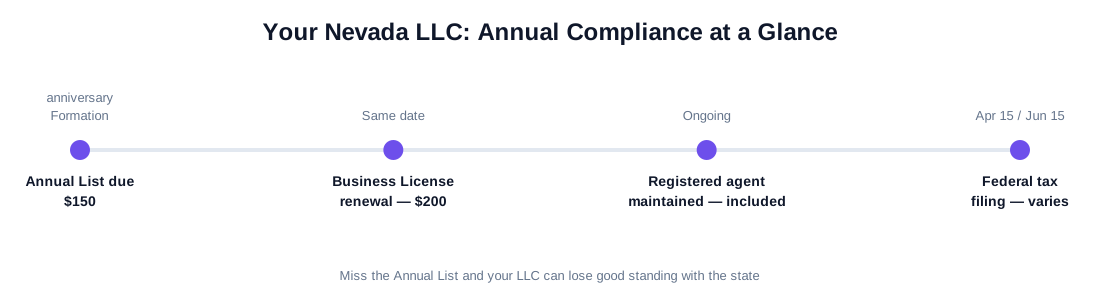
Once formed, your Nevada LLC has ongoing compliance obligations:
| Requirement | Frequency | Approximate Cost |
|---|---|---|
| Annual List of Members/Managers | Annually (by anniversary date) | $150 |
| Nevada State Business License Renewal | Annually | $200 |
| Registered Agent | Annually | Included with eCorp |
| Federal Tax Filing | Annually | Varies by situation |
eCorp's compliance calendar keeps you on top of these deadlines so nothing slips — important when you're hopping time zones every few weeks.
---
Why Nevada Specifically?
Digital nomads often ask: why Nevada and not Wyoming or Delaware?
Nevada's advantages for nomadic entrepreneurs:
- Privacy — member names not publicly listed (Wyoming is also strong here; Delaware is not)
- No state income tax — same as Wyoming, better than most states
- No information-sharing with the IRS — Nevada doesn't share state tax data with federal authorities
- Strong asset protection laws — Nevada has some of the most creditor-protective LLC statutes in the US
- Business Court — dedicated business dispute resolution (only Nevada and Delaware have this)
- Established infrastructure — Nevada has decades of experience with international and remote business formation
For most digital nomads, Nevada or Wyoming are the two best choices. eCorp specializes in Nevada — and we believe it's the stronger option for founders who value both privacy and legal infrastructure. See our full Nevada vs. Wyoming comparison →
---
Get Started Today
Forming a Nevada LLC as a digital nomad takes less than 10 minutes with eCorp. We handle the filing, registered agent, and EIN — so you can stay focused on running your business, wherever in the world that happens to be.
Start your Nevada LLC with eCorp →
---
Note: Tax laws for international businesses and non-resident LLC owners are complex and subject to change. Always consult a qualified tax professional before making decisions about your business structure.