
LLC vs. Corporation: Which Should You Form in 2026?
Editorial Team
eCorp Services
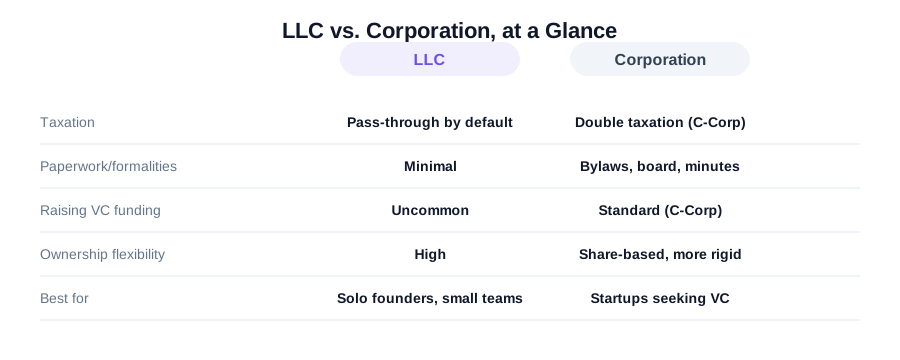
"LLC or corporation?" is usually the first real decision a new founder has to make, and it's one that's easy to get wrong in either direction — treating it as purely a tax question, or picking whatever a friend used without checking if the reasoning still applies to you.
Here's the difference that actually matters, layer by layer.
---
The Core Structural Difference
An LLC (Limited Liability Company) is a hybrid structure: it gives you the liability protection of a corporation with the operational simplicity and tax flexibility of a partnership. A corporation (C-Corp) is a fully separate legal and tax entity from its owners, with a more rigid management structure — a board of directors, officers, and formal shareholder meetings.
Both protect your personal assets from business liabilities. The difference is in everything else: taxes, paperwork, and how investors view them.
Taxation: The Biggest Practical Difference
| LLC | C-Corporation | |
|---|---|---|
| Default tax treatment | Pass-through (profits taxed once, on your personal return) | Double taxation (corporate profits taxed, then dividends taxed again) |
| Can elect S-Corp treatment? | Yes, in many cases | N/A (already a corporation) |
| Nevada corporate income tax | None | None |
| Federal self-employment tax | Applies to active LLC income | Does not apply to corporate profit directly |
Most small businesses and solo founders prefer an LLC specifically to avoid double taxation. A C-Corp only pays corporate tax on its profits; if it then distributes those profits as dividends, shareholders pay tax again on the same money. An LLC's profits pass straight through to the owners' personal tax returns and are taxed once.
Liability Protection: Effectively Equal
Both structures shield your personal assets — your house, personal bank accounts, personal investments — from business debts and lawsuits, as long as you maintain the separation properly (separate bank accounts, no commingling of funds, proper documentation). Neither structure is inherently "safer" than the other on this front.
Management Flexibility
This is where LLCs pull ahead for most small businesses. An LLC can be managed directly by its members (owners) or by an appointed manager, with far fewer formalities — no mandatory board meetings, no required corporate minutes, no rigid officer titles. A corporation requires a board of directors, formal shareholder meetings with documented minutes, and defined officer roles (CEO, CFO, Secretary, etc.), even if you're the only person involved.
If you want to run your business without a lot of corporate formality, an LLC is the simpler path.
Raising Capital & Investors
This is where corporations pull ahead. Venture capital firms and institutional investors overwhelmingly prefer to invest in C-Corporations — specifically Delaware C-Corps — because the stock structure (with defined share classes, vesting schedules, and option pools) is what their investment models are built around. LLCs can raise money, but the membership-interest structure is less standardized and less familiar to VC funds.
If you're planning to raise venture capital, a C-Corp is very likely the right call from day one — converting later is possible but adds legal cost and complexity.
Compliance Burden
| LLC | C-Corporation | |
|---|---|---|
| Annual state filing | Annual List ($150 in Nevada) | Annual List + more extensive corporate records |
| Required meetings | None required | Board + shareholder meetings, with minutes |
| Registered agent required | Yes | Yes |
| Ongoing paperwork | Minimal | Significant |
Both structures need a registered agent and both face Nevada's recurring annual fees — but a corporation's ongoing governance requirements are meaningfully heavier.
Which Should You Choose?
Choose an LLC if: you're bootstrapping or self-funding, want pass-through taxation, want minimal ongoing paperwork, and aren't planning to raise institutional venture capital in the near term. This covers the large majority of solopreneurs, freelancers-turned-agencies, ecommerce sellers, and small service businesses.
Choose a C-Corporation if: you're planning to raise venture capital, want to offer employee stock options, or are building toward an eventual acquisition or IPO where investors will expect a standard corporate structure.
Not sure yet? Most founders who are unsure start with an LLC — it's cheaper to form, simpler to run, and if your plans change later, converting to a C-Corp is a well-trodden legal path. Starting as a C-Corp and later wishing you'd kept things simple is a much more common regret.
See our full guide to what a Nevada LLC costs to form and maintain →